Are Smokeless Fire Pits Worth It?
Smokeless fire pits are worth it for frequent wood fires when smoke spoils the evening. Choose one if you can provide dry fuel and a safe outdoor space; skip it if you want instant shutoff or no wood cleanup.
On this page (8 sections)
- Are smokeless fire pits worth it for your routine?
- How does a smokeless fire pit reduce smoke?
- What benefits justify the extra cost?
- Which features should you check before buying?
- Which of these three fire pits fits your plans?
- How do you get a cleaner burn from the first fire?
- What mistakes cause smoke, damage, or extra cleanup?
- Are smokeless fire pits worth it for you? Make the final call
Smokeless fire pits are worth it for frequent wood fires when smoke spoils the evening. They suit people who enjoy building a fire and want less smoke around their chairs, while accepting fuel storage, ash removal, and a long cooldown.
The extra value comes from a cleaner-burning fire once it gets hot. It does not come from instant lighting, guaranteed wood savings, or freedom to place the pit anywhere.
Before buying, decide which part of a wood fire you want to improve. If hauling logs and waiting for embers to die are your main complaints, a different fuel may solve more problems.
Are smokeless fire pits worth it for your routine?
A smokeless model is most worthwhile when you burn wood often and smoke is the main nuisance. Occasional users who already enjoy a basic fire bowl have less reason to replace it.
Think about your last few fires: did smoke keep moving people out of their seats, or was finding dry wood the bigger hassle? A low-smoke design addresses the first problem, but you still need to solve the second.
Skip this category if your outdoor space cannot meet wood-fire rules or you want a short fire before bed. You cannot turn off burning logs, so your available time needs to include safe supervision through the end of the burn.
For a broader starting point, our guide to choosing a fire pit by fuel, size, and material helps match the type to your routine.
How does a smokeless fire pit reduce smoke?
Smokeless fire pits use extra airflow to burn more of the particles that would escape as smoke. Many designs heat air inside a double wall and release it near the top of the fire.
This secondary burn needs heat, which explains why lighting can still be smoky. A weak, smoldering fire will not deliver the same benefit as an established flame with dry fuel.
Our guide to how a smokeless fire pit works explains the airflow path in more detail.
Less visible smoke does not make the exhaust harmless. These are outdoor appliances that still produce combustion gases and particles, so never use one in a garage, tent, or enclosed porch.
What benefits justify the extra cost?
The main benefit is less smoke during an established fire, with easier ash removal on models that have removable pans. That combination matters most if it makes you more willing to use the pit regularly.
You can still get smoke on clothes, and wind can carry exhaust toward guests or nearby homes. A smokeless pit is not a solution for a location where any wood smoke would create a problem.
Do not count on lower fuel bills to justify the choice. Efficient combustion can burn wood more fully, but a lively fire may still consume logs quickly.
Include the whole setup in your budget: suitable fuel, dry storage, and any surface protection or accessories required by the model. An included cover or stand is useful only if it meets your actual needs.
Which features should you check before buying?
Choose by approved placement, carrying weight, usable size, and cleanup access. These details matter more than a broad promise of smokeless performance.
Start with the surface and clearances. Measure the space around the pit, including chair positions, walking routes, overhead branches, and nearby furniture, rather than measuring only the empty spot where the bowl will sit.
Next, think about moving it. A compact cylinder can still be awkward to carry, and a heavy model becomes less appealing if every fire involves moving it from a shed.
Check the permitted log length and fuel type before stocking up. Exterior diameter does not tell you exactly how much room is available inside the burn chamber.
Finally, look at how ash comes out. A removable pan helps, but check whether reaching it requires lifting other parts and whether you have room to do that comfortably.
Our fire pit safety basics covers placement and local restrictions before you commit to a model.
Which of these three fire pits fits your plans?
Choose the OutVue for larger gatherings, Bonfire for regular moves, or TIKI for a settled patio setup with flexible fueling. Each solves a different practical problem.
OutVue: are larger smokeless fire pits worth it?
The OutVue 27-Inch Smokeless suits larger backyard gatherings on an approved surface. OutVue describes it as suitable for 7–10 people, though chair spacing still needs to follow its clearance instructions.
It measures 27 in across and 19.2 in high, with a weight of 47.5 lb. Tool-free assembly helps with setup, but that weight makes it better for occasional relocation than frequent carrying.
The stainless steel body has a removable ash tray, and a poker and waterproof cover are included. OutVue allows wood or pellets, so follow its instructions for loading the fuel you choose.
Skip it if grass or a wooden floor is your only available location: OutVue prohibits both surfaces. It is also the wrong choice if easy solo transport matters more than gathering size.
Solo Stove Bonfire: the choice for regular moves
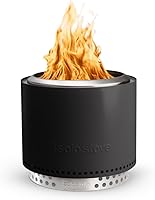
The Solo Stove Bonfire with Stand suits buyers sharing one fire pit between home and trips. At 21.7 lb, it is substantially lighter than the other two options here.
Its body is about 19.5 in across, and Solo Stove describes it as suitable for 4–6 people. The included stand, removable base plate, and ash pan make this a useful package for a smaller gathering.
It uses 304 stainless steel with a high-heat ceramic coating. Follow Solo Stove's surface guidance even with the stand fitted, because an accessory does not make every location suitable.
Skip it if you want the larger gathering size of the OutVue or expect to leave the pit in one place permanently. Its main advantage in this comparison is easier transport.
TIKI Patio: the choice for a regular gathering spot
The TIKI Patio 25-Inch Smokeless suits a patio where the fire pit will usually stay put. It burns natural cut firewood or TIKI Wood Packs, giving you a choice between loose logs and a ready-to-light fuel option.
It measures 24.75 in across and weighs 45 lb, with 16-gauge stainless steel and a black powder-coated finish. A stand, weather-resistant cover, and removable ash pan are included.
TIKI describes it as suitable for 4–6 people and claims a 4 ft heat radius. Use that as a guide rather than a promise that everyone will feel equally warm in wind or cold weather.
Skip it for frequent campsite carrying or if you do not value the wood-pack option. Optional cooking and heat accessories are sold separately, so include them only if they support how you plan to use it.
How do you get a cleaner burn from the first fire?
Use dry fuel, clear vents, and a modest starting fire. Good setup gives the airflow system a chance to work without burying the flame under too much wood.
Follow this routine:
- Choose the site before lighting. Set the pit on a level, approved surface and meet the model's clearances.
- Check the airflow path. Remove old ash as directed and make sure vents are open.
- Start with kindling. Build a small flame before adding larger pieces, leaving gaps for air.
- Keep fuel within the chamber. Follow the maximum fill guidance and avoid stacking logs above the recommended level.
- Feed the fire gradually. Add wood while a strong flame remains rather than waiting for a nearly dead fire and piling it full.
Damp wood wastes heat as moisture evaporates and can create more smoke. Our guide to wood for a smokeless fire pit explains fuel selection and storage.
For Bonfire setup and lighting steps, see how to light and use a Solo Stove.
What mistakes cause smoke, damage, or extra cleanup?
The common mistakes are overloading, burning unsuitable material, and covering the pit too soon. A low-smoke design cannot overcome blocked airflow or careless storage.
Do not burn trash, treated lumber, or painted wood. Use only fuels approved for the specific model; pellet compatibility on one fire pit does not apply to every other pit.
Stop adding logs early enough to let the fire burn down under supervision. Follow the manufacturer's extinguishing directions rather than treating a cover as a way to put out flames.
Once everything is completely cold, remove ash and clear vents as directed. Put ash in a lidded metal container away from combustible materials, since buried embers can remain hot.
Keep the cooled pit dry between uses and avoid scraping coated surfaces with unsuitable tools. Stainless steel still needs care, and a cover works best over a clean, dry unit.
Are smokeless fire pits worth it for you? Make the final call
Smokeless fire pits are worth it when you want wood flames often enough to justify the fuel, space, and care. Choose OutVue for a larger group on a suitable surface, Bonfire for easier transport, or TIKI for a regular patio spot with wood-pack flexibility.
Keep a basic wood pit if occasional fires already meet your needs. Choose propane if quick starts and shutoff matter more than burning logs; our propane versus wood comparison explains that tradeoff.
Before ordering, confirm the model fits both your planned location and your storage space. Then use our guide to smokeless wood fire pits to narrow the category around those requirements.
Frequently asked questions
Are smokeless fire pits completely smokeless?
No, smokeless fire pits reduce smoke rather than eliminate it. Expect some smoke during lighting and as the fire cools, with more possible from damp wood or blocked airflow.
Dry fuel, an open path through the vents, and logs kept below the recommended fill level help the fire burn cleanly.
Do smokeless fire pits use less wood?
Not necessarily. More complete combustion does not guarantee that your wood supply will last longer, and a strong fire can consume fuel quickly.
Fire size, log size, weather, and session length all affect consumption.
Buy for reduced smoke rather than expected fuel savings, and add only enough wood for the fire you need.
Are smokeless fire pits safe on a deck?
Only use a smokeless fire pit on a deck when its instructions allow that surface and you can meet every clearance requirement. An included stand does not approve every deck material or layout.
Check the deck manufacturer's guidance too, and keep the fire clear of railings, furniture, and anything overhead.
Is a smokeless fire pit easier to clean?
A removable ash pan makes ash removal easier, but you still need to wait until the fire pit and ash are completely cold. Empty ash into a metal container with a lid, keep it away from combustible materials, and clear blocked vents as directed.
Cover the fire pit only after cooling.